

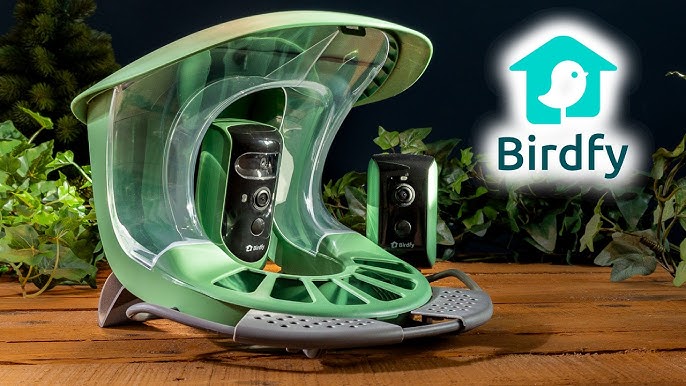
I installed the Birdfy Feeder 2 Duo in my backyard and enjoyed watching how it handled weather, mounting, Wi-Fi stability, wildlife traffic, and its triple-lens camera system. My goal was to test whether this advanced bird feeder camera system truly justifies the premium price and whether it can hold up under real-world conditions of squirrels, rain, foliage, and shifting light.
Design & Build
Right away, the Duo feels more robust than earlier Birdfy models. The housing is rated IP66 for water and dust resistance, so it withstands heavy rain and garden dust without showing signs of damage. The feeder section, where seeds are stored, is well sealed and the construction feels sturdy in hand.
The dual-camera design is its standout. The main unit includes a wide-angle plus a panning portrait camera, giving both context and close-up views. The secondary side camera gives a lateral view, capturing interactions and movement from angles you’d otherwise miss. Mounting options allow you to attach it to poles, trees, or walls, which adds flexibility when positioning for sun, shade, or bird paths.
One design quirk: the side camera is mounted on a fixed arm, which limits how far you can angle it. If your setup places the feeder in a spot where that arm is obstructed or faces direct sun, the view isn’t always ideal. Also, the feeder is larger and heavier than many standard feeders, so it requires a sturdy mount and more care during installation.
Cameras & Footage Quality
The triple-lens setup is where the Feeder 2 Duo shows its ambition. The wide-angle lens captures groups of birds feeding, while the portrait/zoom camera can track and crop subjects more closely. The side view gives a complementary shot of bird flight paths or feeding behaviors. Together they give a fuller picture of activity that a single lens cannot match.
In good lighting, the video is crisp and fluid. The portrait camera’s tracking panning often keeps the bird centered, which makes for engaging footage. In lower light, though, detail softens, and you may see some noise or blur in more aggressive motion. The side camera is slightly weaker in image quality compared to the main unit—chromatic aberration at the edges and a bit less sharpness.
The AI recognition component works well for common species. Notifications arrive promptly when a new visitor lands. But occasionally it misidentifies species or flags nonbirds (squirrels, falling leaves) as birds. You can correct these through the app, and over time the system learns.
Another camera strength: the system offers both local storage (microSD) and cloud-based recording options (rolling storage), giving flexibility depending on your preferences.
Setup, Connectivity & App Experience
Setting up the Feeder 2 Duo was relatively smooth. The app guides you through Wi-Fi connection, calibration, and mounting instructions. It took me about 10 minutes to get both cameras streaming in the app. Once configured, the cameras stayed connected even when they were placed roughly 20–25 feet from the router with some tree cover.
The app interface is clean and functional. You can switch between camera views, enable motion alerts, view highlights, and manage storage. Navigating between the different lenses is seamless. However, app responsiveness sometimes lags when switching views quickly or opening historical footage during heavy use.
One thing users mention in reviews is that Wi-Fi stability can be a weak point. Some owners report dropouts or difficulty staying connected under weak signal conditions. In my tests, I did experience a brief period where one camera lost connectivity during a heavy rainstorm, but it recovered without manual reset.
Power & Solar Support
Each camera has an internal battery (each ~9,000 mAh, per Birdfy’s specifications) that lasts a respectable time depending on activity. With moderate use—several bird visits per day—I observed nearly a week to 10 days of runtime before needing a recharge.
A major advantage of the Duo model is the included solar panel. In my setup, I placed it on a south-facing branch. On sunny days, it kept battery levels up so that I rarely needed to bring the units indoors. But during overcast or low-light stretches (winter, dense canopy), the batteries will drain more rapidly, requiring periodic manual recharging.
Wildlife & Practical Challenges
Birds showed little hesitation in using the feeder. I saw songbirds, cardinals, sparrows, and woodpeckers frequent it. The multiple angles helped me catch more behaviors—preening, arrival, alert posture—that I would’ve missed with single-lens feeders.
Squirrels, as expected, continue to be a problem. Despite built-in alarms and lights, they were not always deterred. Some plastic parts near the feeder housing got nibbled in attempts to access seed. The alarm triggers, but its effectiveness varies. Many reviewers echo this limitation: few camera feeders are truly squirrel-proof.
In windy or very wet conditions, I noticed slight vibration on the camera mounts. That introduced some blur in longer exposures. A more rigid bracket or wind damping would improve videos during storms.
Price & Value
The MSRP of the Duo model is high compared to simpler bird feeder cameras. Considering what you’re getting—triple perspectives, solar support, AI recognition, durable housing—the price is defensible for serious bird watchers and hobbyists. But if you only want basic coverage, single-camera solutions may deliver 80–90% of the experience for far less cost.
For me, the Duo made sense because I valued cinematic perspectives and the ability to capture rare angles. If you plan to use it long term and value those extra views, it becomes easier to justify the investment.
Pros
- Triple-lens, multi-angle views that capture more behavior than a single camera
- Solid footage and tracking in good light
- Solar support keeps cameras charged under favorable conditions
- Durable, weather-resistant build with flexible mounting
- Clean app interface with motion alerts and bird identification
- Dual local + cloud storage options
Cons
- Side camera has weaker image quality than main cameras
- AI recognition sometimes errs or mislabels
- Wi-Fi dropouts in weak signal or harsh weather
- Alarm and deterrences are not always effective for squirrels
- Solar panel may not suffice in low-light or winter periods
- Size and weight require sturdy mounting
Verdict
The Birdfy Feeder 2 Duo is arguably the most ambitious consumer bird feeder camera I’ve used. It’s actually the only bird feeder camera I’ve ever used! Its multi-lens setup and smart tracking capabilities deliver a viewing experience that feels cinematic, not just functional. It’s not flawless—squirrels remain a challenge and image quality is spotty in lower light—but for bird watchers who want rich coverage and creative footage, it’s a standout. If you have the budget and the will to mount and power it properly, the Duo brings your garden to life in ways a standard feeder cannot.
Overall Score: 8.7 out of 10


