

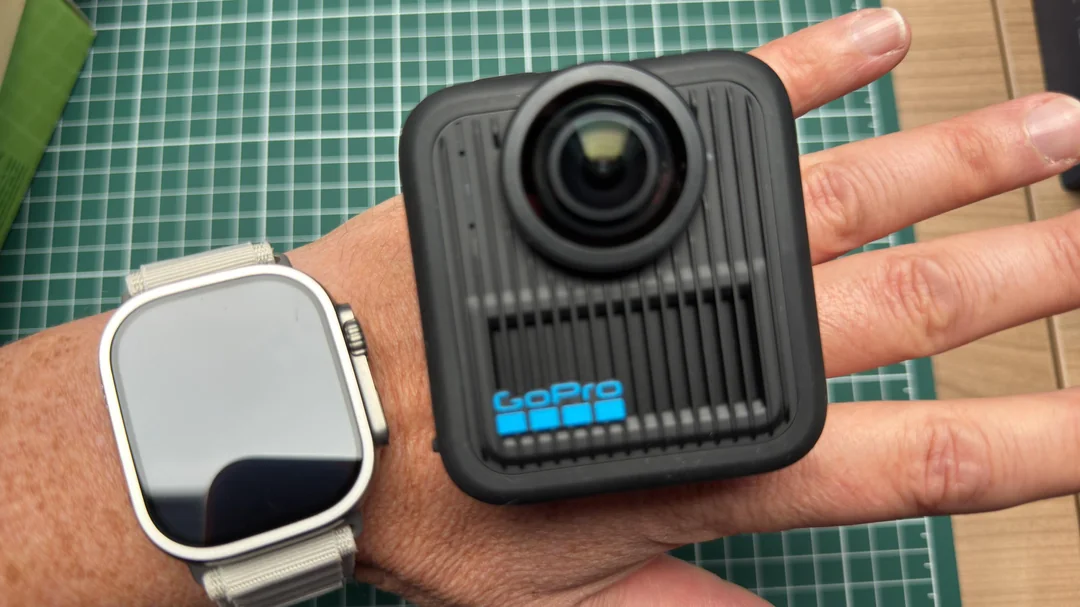
I spent several days testing the GoPro Max 2 across different scenarios: hiking along the coast, biking through trails, and capturing slow-motion clips underwater. The goal was to see whether this new version could deliver pro-level video quality in a camera that anyone can actually use. After a week of filming and editing, it is clear that the Max 2 is a big improvement in image quality, stability, and flexibility, even if a few rough edges remain.
Design and Build
The Max 2 keeps the classic GoPro look, but it feels sturdier. The textured body is easy to grip, and the protective lens covers now twist off for quick swaps or replacements. The camera is waterproof up to five meters without a housing, making it ideal for pool shots or light diving. Buttons are tactile, the latch seals tightly, and the overall build quality inspires confidence.
The touchscreen is larger and more responsive than the first Max, which makes navigation faster. I could review clips and change frame rates easily, even while wearing gloves. The design feels intentional, combining toughness with real usability.
Features and Performance
The headline feature is 8K 360-degree recording at 30 fps. The jump in resolution makes a noticeable difference. You can crop into footage without losing sharpness, and the detail in textures, foliage, and reflections looks far cleaner than before. If you prefer smoother motion, 5.6K at 60 fps or 4K at 100 fps are both solid options.
GoPro’s HyperSmooth stabilization remains one of the best in the business. Even on rough trails, the horizon stayed perfectly level. When I mounted the Max 2 on a bike, the footage looked cinematic rather than shaky. The new AI reframing tool inside the Quik app makes editing 360-degree clips much easier. You can tilt, pan, or follow a subject in post without complex software.
Audio has been improved as well. The six-microphone layout records cleaner directional sound, reducing wind noise outdoors. Voice commands now trigger more reliably, even in noisy environments.
Real-World Testing
During daylight hikes, I filmed scenes where sunlight reflected off water and cliffs. The Max 2 handled highlights well, preserving texture instead of washing out bright areas. Shadows retained detail, and color balance stayed natural without drifting too warm.
In low-light conditions, such as shaded forest paths, the image showed some grain but remained usable. I noticed the AI tracking occasionally struggled in very dark sections, sometimes losing a subject for a few frames.
Underwater, the footage was crisp in shallow water, though color leaned slightly blue at depth. Adding a red filter corrected this quickly. The waterproof design worked flawlessly with no leaks or condensation.
For motion tests, I filmed bike rides, hand-held walks, and a quick time-lapse. The stabilization stayed steady throughout. The horizon lock feature makes it possible to spin the camera freely while the video remains level. It is an impressive effect that works exactly as advertised.
Battery and App Experience
Battery life depends heavily on recording mode. Shooting 8K drained it in about 55 minutes, while 5.6K lasted closer to 80. The camera charges fast through USB-C, and battery swaps are simple. However, recording in 8K generates large files that demand a high-speed microSD card and eat through storage quickly.
The companion app feels more stable than before, but it still lags when previewing or transferring large 8K clips. On a strong Wi-Fi 6 connection, transfers were reliable, yet editing inside the app sometimes caused minor slowdowns. Using a desktop workflow with GoPro Player or DaVinci Resolve gave smoother results.
Pros
- Crisp 8K 360-degree video with excellent detail
- Swappable lenses for easy maintenance and versatility
- Outstanding stabilization in both 360 and single-lens modes
- Rugged and waterproof design
- Improved touchscreen and menu navigation
- Clearer directional audio
Cons
- Battery life drops quickly in 8K recording
- Occasional lag in the mobile app
- Visible noise in darker scenes
- Very large file sizes require fast storage
- Slight color shift underwater without filters
Verdict
The GoPro Max 2 takes a major leap forward for immersive video. Its combination of 8K recording, near-perfect stabilization, and modular lenses make it one of the most flexible cameras on the market. While it is not flawless, the improvements make it far easier to recommend to anyone serious about capturing action or travel footage in every direction.
It is powerful, creative, and ready for nearly anything you can throw at it.
Overall Score: 8.4 out of 10