

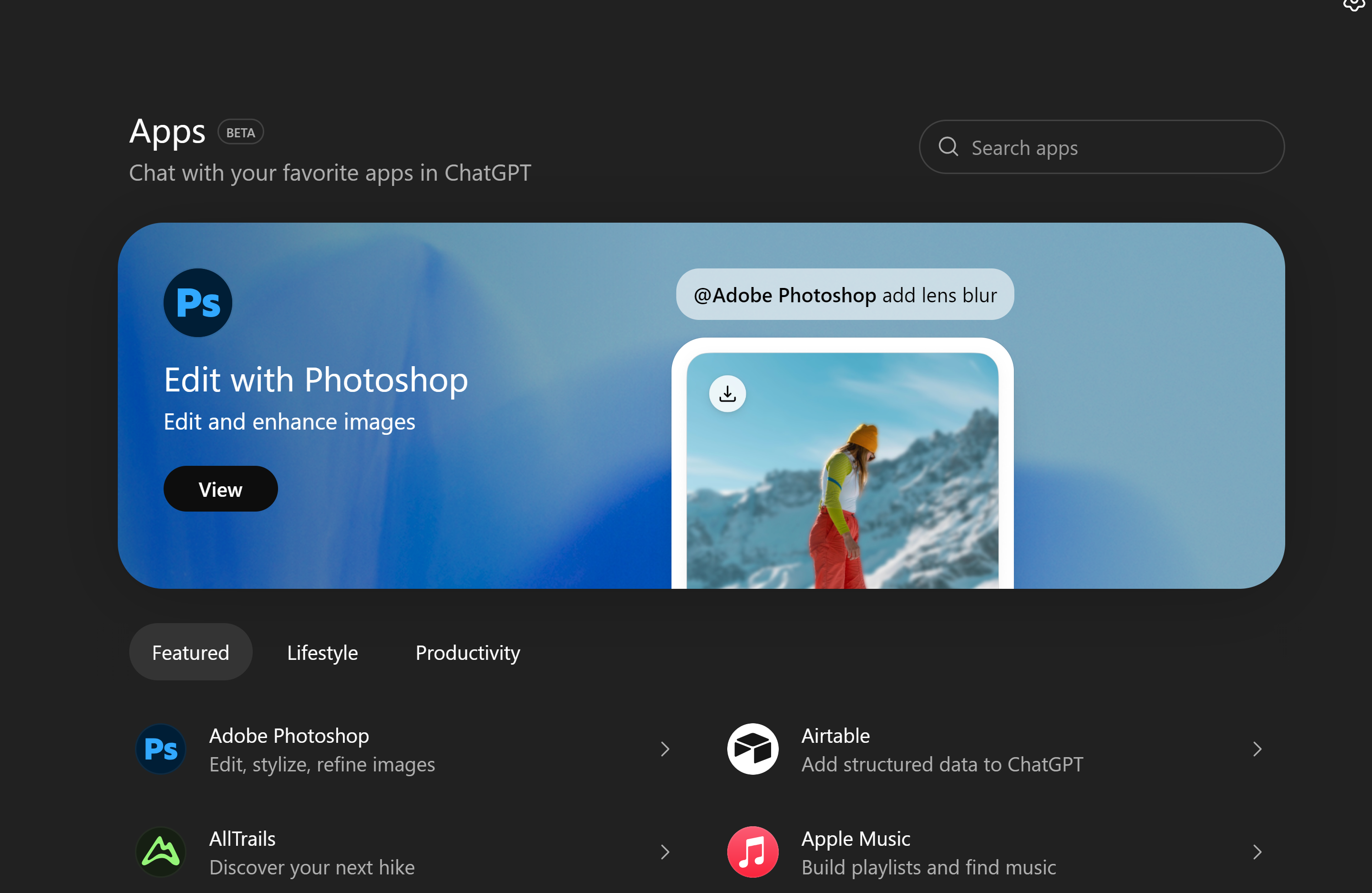
OpenAI has launched a way for users to browse and interact with apps directly inside ChatGPT, marking a big shift in how people use the AI chatbot. Instead of just generating text and answering questions, ChatGPT can now act as a platform where users discover, install and interact with third-party apps. The new system is rolling out now, with an in-product app directory and developer tools that make it easier for creators to build and publish work inside the chat interface.
For users, the change means they can pull in structured tools and services straight into their conversations. Apps let ChatGPT extend what it can do, bringing in fresh data, interactive interfaces and real-world actions without leaving the conversation. Some early examples include tools that help organize music libraries, search for housing, design slides, or perform research tasks. These apps appear alongside chat text and can be invoked simply by mentioning their names in a prompt or selecting them from a menu.
Developers can now submit their own apps for review and publication in the app directory. OpenAI has opened the submission process and provided guidelines and resources to help creators build high-quality apps that fit naturally into chat. Once developers follow the requirements and pass OpenAI’s review process, their apps can appear in the directory for users worldwide to discover and use.
The app ecosystem in ChatGPT is designed to blend conversational AI with interactive functionality. That means apps are not just simple plug-ins; they are built to work inside the back-and-forth flow of an AI conversation. Users might start with a simple question and end up using an app-powered tool without leaving the chat, turning ideas into actions — like ordering groceries, generating presentations from outlines, or browsing listings — with a few lines of conversation.
Integration works in part by respecting context and personalization. Apps can tap into ChatGPT’s memory feature — if a user has opted in — so the experience feels tailored to that user’s habits and needs. Users control which apps are connected and can disconnect them at any time. When they connect an app, ChatGPT clearly explains what data will be shared and how the app’s own privacy policy applies.
This launch builds on earlier work in the ChatGPT ecosystem. Last year, OpenAI introduced a software development kit that let developers create chat-native tools, and the concept of blending AI with external services has been evolving for months. Now, with an accessible directory and submission path, OpenAI hopes to bring a wide range of interactive apps into everyday use.
Because these apps live inside ChatGPT and work alongside natural language interaction, the experience is different from traditional mobile or desktop app stores. Users don’t have to switch away from a conversation to perform tasks or pull in real-world data. Instead, the AI and apps work together in a unified interface that aims to streamline workflows and expand what people can do with a single tool.
OpenAI’s approach could reshape how people think about software and AI. By turning ChatGPT into a host for interactive tools, the company is testing whether conversational interfaces can replace or augment conventional app ecosystems. For users, that might mean fewer context switches, more seamless workflows, and a richer way to get things done. For developers, it opens up a new channel to reach millions of people who already use the chatbot every day.
The new app directory is now accessible through ChatGPT’s navigation pane or directly through a dedicated URL. Early rollout includes a handful of major services, and more will become available over time as developers publish new tools and OpenAI expands the catalog. This represents one of the biggest shifts for ChatGPT since its launch, pushing the AI beyond a text generator and into a tool platform that blends conversation with functionality.