

When NVIDIA announced the RTX 5090 Founders Edition, I was both excited and cautious. It promised unmatched performance with 32 GB of GDDR7 memory, a redesigned cooling system, and a massive power draw. I tested it for over a week across demanding games, creative workflows, and rendering tasks to find out whether it truly represents a generational leap or simply flexes its strength through raw power alone.
Design & Build
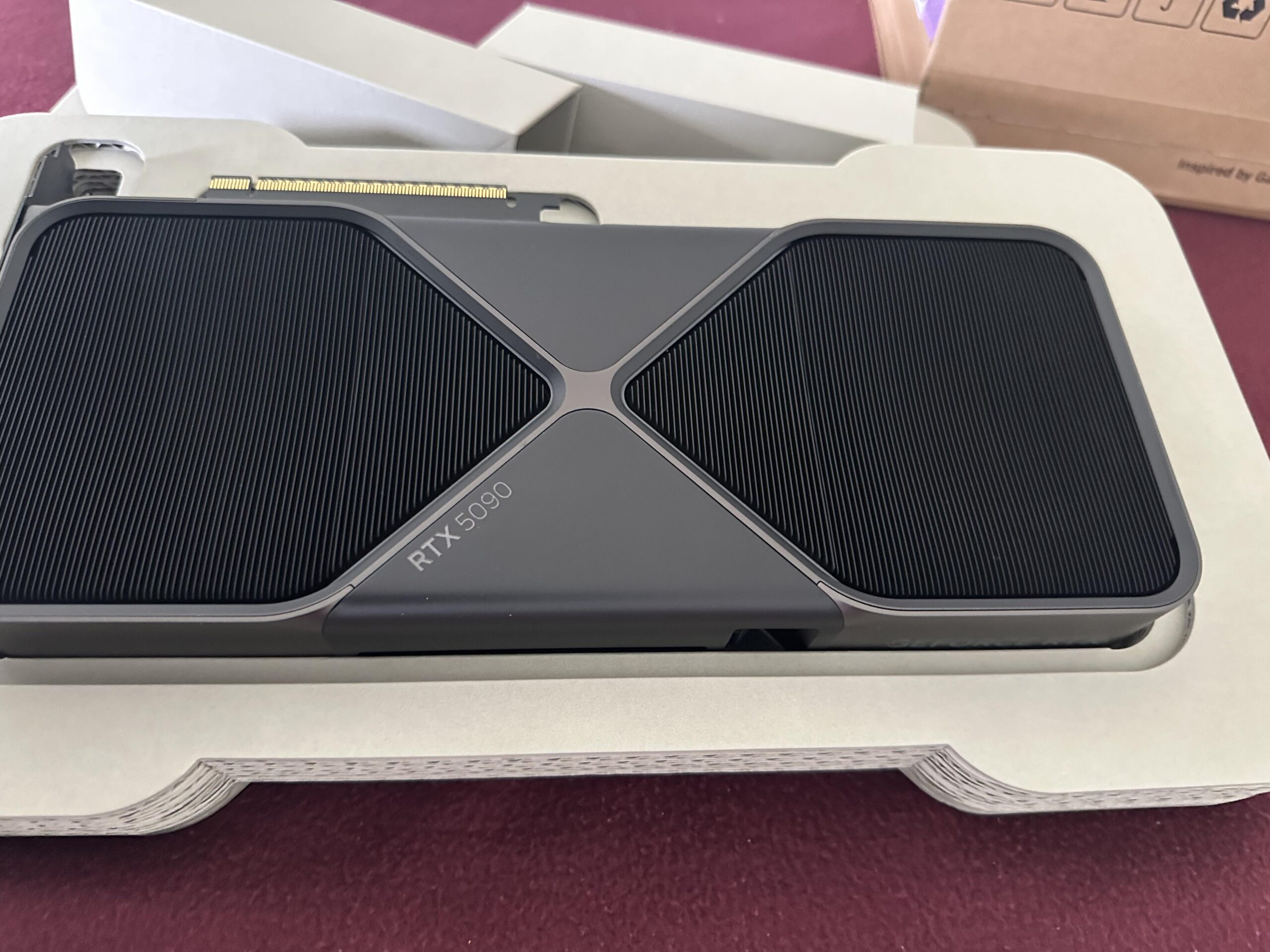
The RTX 5090 Founders Edition has a sleek, industrial look with a matte black finish and a bold geometric fan design. Despite its immense power, NVIDIA managed to keep it to a dual-slot form factor, which is impressive considering its 575-watt power rating. The cooling shroud feels premium, the backplate is solid, and the airflow channels are intelligently designed for both aesthetics and function.
Measuring around 304 mm in length, the card fits comfortably into most full-size ATX cases, but you’ll still need good airflow and a sturdy mount. The fans are quiet during casual use but ramp up when pushed under heavy load. They produce a steady white noise that is noticeable but not distracting. NVIDIA has also switched to the new 12V-2×6 connector, which feels more secure and stable than the 12VHPWR connector from the previous generation.
Performance & Features
Performance is where the RTX 5090 FE establishes its dominance. Across multiple benchmarks and real-world tests, it consistently outperformed the RTX 4090 by 25 to 35 percent, depending on the application. In high-end gaming at 4K, I was able to push ultra settings in nearly every modern title while maintaining smooth frame rates well above 120 fps.
Ray tracing performance is outstanding. Games like Cyberpunk 2077, Alan Wake 2, and Control ran effortlessly with full ray tracing enabled. The new DLSS 4 support also brings frame generation and neural rendering improvements, allowing games to achieve higher performance without compromising visual quality. NVIDIA’s AI-driven rendering techniques are finally mature enough to feel native rather than artificial.
The increase to 32 GB of GDDR7 memory makes a real difference in professional workloads. Tasks like 3D modeling, 8K video editing, and AI training felt faster and more stable. Export times in Adobe Premiere and DaVinci Resolve were significantly lower compared to the RTX 4090, and large datasets loaded more smoothly in Blender and Unreal Engine.
Thermal performance is excellent for such a power-hungry card. The redesigned vapor chamber and fan layout keep temperatures in check, rarely exceeding 80 degrees Celsius under continuous heavy load. However, it does require a capable power supply and strong case ventilation. My system draw peaked at nearly 900 watts under full stress, so you’ll need a 1200W PSU to maintain stability with headroom for the rest of your build.
Power and Cooling
The RTX 5090 Founders Edition draws up to 575 watts, making it one of the most power-intensive GPUs ever released. NVIDIA’s cooling solution manages the heat well, but your case airflow and PSU quality become critical factors in ensuring consistent performance. In my testing, GPU temperatures stabilized in the high 70s even during marathon sessions, and fan speeds adjusted smoothly based on system load.
Acoustically, it’s manageable. The fans are audible under sustained load, but the tone is even and free of high-pitched noise. When idle or performing light tasks, the card remains silent. NVIDIA has also improved the fan bearings and curves for smoother transitions between load states, which helps reduce sudden noise spikes during gameplay or rendering.
Price and Value
At a launch price of around $1,999, the RTX 5090 Founders Edition sits firmly at the top of the GPU hierarchy. It’s not meant for casual gamers but for enthusiasts, professionals, and creators who need the very best. The price is steep, but so is the performance. Compared to the RTX 4090, the 5090 offers meaningful gains in both raw power and memory capacity, making it a more future-proof option for high-end workloads.
That said, it’s important to consider the total cost of ownership. This card practically requires a high-end PSU, efficient cooling, and a large case. For gamers who primarily play at 1440p or standard 4K, a 5080 or 4090 might deliver better value. But for anyone who works with large creative projects, AI workloads, or ultra-high-resolution gaming, the RTX 5090 FE justifies its price through performance alone.
Pros and Cons
Pros
- Incredible performance in gaming and creative workloads
- 32 GB of GDDR7 memory for heavy applications
- Improved DLSS 4 and AI rendering features
- Excellent thermal management for a 575W card
- Refined and quiet cooling system
- Build quality and form factor are top-tier
Cons
- Very high power draw requiring a strong PSU
- Expensive compared to other high-end options
- Limited efficiency improvements over the 4090
- Requires a well-ventilated case to reach full potential
Verdict
The RTX 5090 Founders Edition is an undeniable powerhouse. It pushes boundaries in both gaming and productivity, handling 4K, 8K, and AI workloads with ease. While it comes with high power demands and an equally high price tag, its performance leaves little to complain about. For enthusiasts and professionals who want the best available GPU right now, this is the one to beat.
Overall Score: 9 out of 10


