

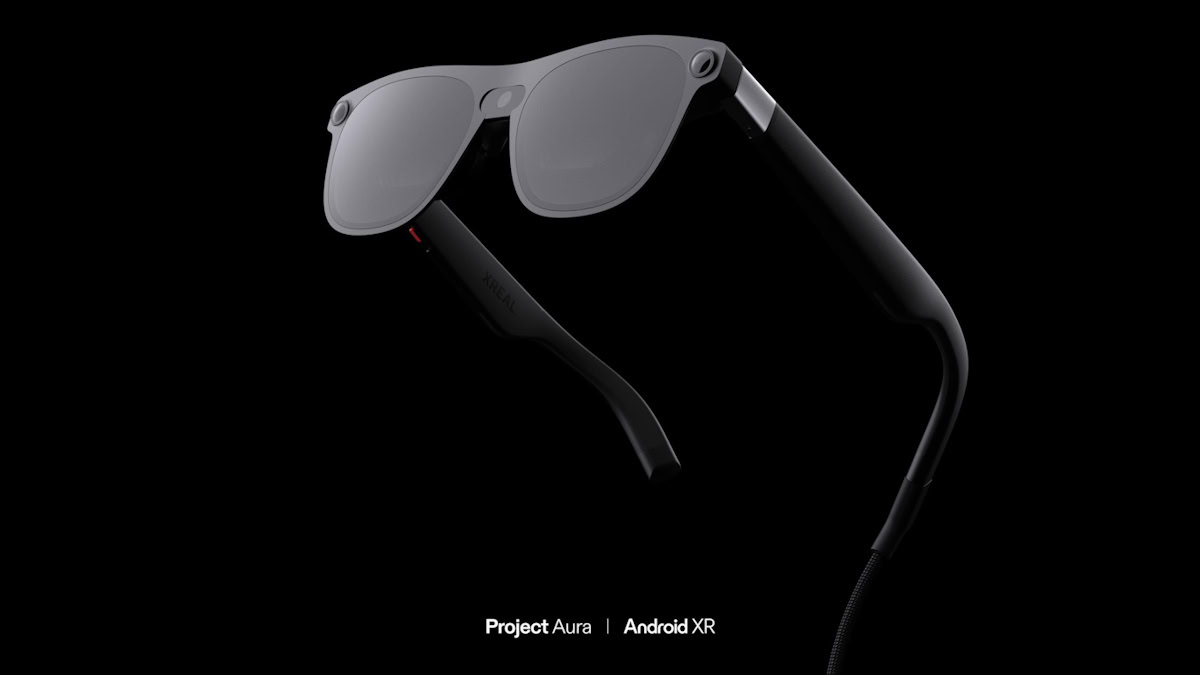
Xreal’s Project Aura could change what we expect from smart glasses. The first real images and a short video clip of the device in use give the clearest look yet at a sleek, lightweight pair of AR glasses built to run Android XR. Rather than a bulky VR headset, Aura looks more like a pair of high-tech sunglasses with serious computing power behind them.
What sets Aura apart from most AR and VR hardware is its design philosophy. The glasses use flat-prism lenses that provide a wide field of view — roughly 70 degrees — while keeping the frame compact. The goal is to give users a cinematic spatial-computing experience without requiring a helmet-like headset. Inside the frame sits a custom X1S chip, with heavier processing handled by a tethered compute puck powered by a Snapdragon-class XR processor. Offloading the bulk of the processing to the puck keeps the glasses themselves lightweight and comfortable.
That compute puck is essential to how the system works. Xreal has confirmed that you won’t be able to rely on a regular smartphone to power Aura; the dedicated puck is required for spatial tasks and Android XR applications. Separating the compute unit from the glasses echoes other XR designs that prioritize comfort without sacrificing performance.
Because Aura runs Android XR, it immediately benefits from a broad ecosystem of apps. XR-optimized games, productivity tools, spatial interfaces and AR utilities are expected to work without developers needing to tailor them specifically to glasses hardware. Xreal’s leadership has described Aura as a breakthrough moment for real-world XR, suggesting that this hardware and software combination could shift smart glasses from niche tech to something people actually want to wear daily.
The practical possibilities are wide. Users could check email or watch videos on a virtual floating display while still seeing their surroundings. Live translation text could appear in real time. Navigation markers could overlay onto the real world. Task lists and reminders could live in a subtle corner of your vision. Aura’s design makes it clear that Xreal wants AR to integrate into normal routines rather than replace them.
Xreal has not confirmed pricing or an exact release date, though industry expectations point toward sometime in 2026. Battery life, display clarity, comfort over long sessions and how well applications truly perform through the compute puck are all unknowns. The reliance on an external compute unit also presents trade-offs between portability and power.
Project Aura feels like a significant step for the XR category. Not just for Xreal, but for Android XR and for the broader push toward mainstream AR glasses. If the device ships with the performance and usability the company hints at, it could mark one of the first real moves toward everyday wearable spatial computing.